
Anaerobic treatment is an essential technology in modern wastewater management. By leveraging anaerobic microorganisms, this method transforms organic pollutants into energy-rich biogas while reducing sludge production. This article provides a comprehensive guide to anaerobic treatment, covering principles, equipment, key parameters, and practical applications.
Table of Contents
Introduction
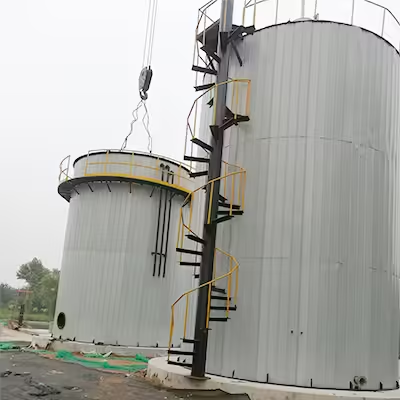
Why Anaerobic Treatment Matters
Wastewater treatment is critical for environmental protection and sustainable water management. Anaerobic treatment offers:
- Energy recovery through biogas
- Reduced sludge generation
- Low operational costs
- Effective removal of high-strength organic pollutants
This makes anaerobic processes highly suitable for industrial and municipal wastewater applications.
Scope of Anaerobic Treatment
- Industrial wastewater: food processing, breweries, paper mills
- Municipal sewage: pre-treatment for high-strength streams
- Agricultural runoff and organic-rich effluents
Principles of Anaerobic Treatment
Anaerobic treatment relies on microbial degradation of organic pollutants without oxygen. The process occurs in several sequential stages:
Key Biochemical Stages
- Hydrolysis – Complex organic matter is broken down into simpler compounds
- Acidogenesis – Simple sugars and amino acids convert into volatile fatty acids (VFAs)
- Acetogenesis – VFAs are transformed into acetic acid, hydrogen, and CO₂
- Methanogenesis – Methanogenic bacteria convert acetic acid and hydrogen into methane (CH₄) and carbon dioxide (CO₂)
Elements Influencing Anaerobic Treatment
- Carbon sources (COD/BOD levels)
- Nitrogen and phosphorus for microbial growth
- Trace elements:
- Iron (Fe) – enzyme cofactor
- Nickel (Ni) – supports methanogens
- Cobalt (Co) – aids methane production
- Alkalinity and pH buffering agents
Types of Anaerobic Treatment Equipment
There are several types of anaerobic reactors, each with unique design elements and applications.
UASB Reactor (Upflow Anaerobic Sludge Blanket)

- Design: Upflow configuration with dense microbial sludge granules
- Advantages: High organic removal, compact footprint
- Best for: Brewery, food, and high-strength wastewater
ABR Reactor (Anaerobic Baffled Reactor)
- Design: Multi-chamber system with baffles directing flow
- Advantages: Stable performance, easy maintenance
- Best for: Industrial effluents with variable load
IC Reactor (Internal Circulation)
- Design: Combines UASB and circulation loops for high efficiency
- Advantages: Handles high organic loads
- Best for: Large-scale industrial wastewater
EGSB Reactor (Expanded Granular Sludge Bed)
- Design: High upflow velocity for expanded sludge bed
- Advantages: Maximum biogas production
- Best for: Wastewater with high COD (>10,000 mg/L)
Comparison of Anaerobic Equipment
| Reactor Type | Organic Load Capacity | Sludge Retention | Biogas Yield | Complexity |
|---|---|---|---|---|
| UASB | Medium | High | Medium | Low |
| ABR | Medium-Low | Moderate | Low-Medium | Low |
| IC | High | High | High | Medium |
| EGSB | Very High | High | Very High | High |
Key Design Parameters in Anaerobic Treatment
Critical Elements for Effective Operation
- Hydraulic Retention Time (HRT) – Controls contact between wastewater and microbes
- Organic Loading Rate (OLR) – Determines microbial activity and biogas production
- Temperature – Mesophilic (30–38°C) or thermophilic (50–60°C) regimes
- pH & Alkalinity – Maintains microbial activity
- Nutrients & Trace Elements – Fe, Co, Ni, Mo, Zn
Recommended Parameter Ranges for Wastewater Types
| Parameter | Domestic Sewage | Food Industry Wastewater | Paper Mill Wastewater |
|---|---|---|---|
| HRT (hrs) | 12–24 | 20–48 | 24–36 |
| OLR (kg COD/m³·day) | 1–2 | 3–6 | 2–5 |
| pH | 6.8–7.5 | 6.5–7.5 | 6.8–7.5 |
| Temp (°C) | 30–35 | 30–38 | 30–35 |
Operation and Process Management

Startup and Seeding
- Inoculate reactor with active anaerobic sludge
- Gradually increase organic load to acclimate microbes
Monitoring and Control
- Temperature control (avoid thermal shock)
- pH and alkalinity monitoring
- Gas production tracking (CH₄/CO₂ ratio)
- Sludge recycle management
Automation
- SCADA or sensor-based systems
- Online COD/BOD monitoring
- Flow and temperature control loops
Wastewater Treatment Efficiency
Performance Indicators
- COD/BOD removal efficiency
- Suspended solids (SS) reduction
- Biogas production (methane yield)
Example Performance Data
| Reactor Type | COD Removal (%) | BOD Removal (%) | Methane Yield (m³/kg COD) |
|---|---|---|---|
| UASB | 70–85 | 75–90 | 0.25–0.35 |
| ABR | 65–80 | 70–85 | 0.20–0.30 |
| IC | 80–90 | 85–95 | 0.30–0.40 |
| EGSB | 85–95 | 90–95 | 0.35–0.45 |
Advantages and Limitations
Advantages
- Energy recovery from methane
- Reduced sludge production
- High efficiency for high-strength organic wastewater
Limitations
- Sensitive to low temperature
- Long startup period
- Toxic substances can inhibit microbes
Comparing Anaerobic vs Aerobic Treatment
| Feature | Anaerobic | Aerobic |
|---|---|---|
| Energy Cost | Low | High (aeration) |
| Sludge Production | Low | High |
| Biogas Generation | Yes | No |
| COD Removal | Moderate-High | High |
| Startup Time | Longer | Shorter |
Practical Applications and Case Studies
Industrial Wastewater
- Breweries: COD removal 80–90%
- Food processing: Biogas capture and energy reuse
- Paper and pulp: High-strength effluent treatment
Municipal Sewage
- Pre-treatment to reduce organic load
- Combined anaerobic-aerobic systems for efficiency
Benefits Realized
- Energy self-sufficiency
- Reduced chemical usage
- Stable effluent quality for discharge or reuse
Conclusion
Anaerobic treatment is a versatile, sustainable, and energy-efficient solution for managing organic-rich wastewater. When selecting a reactor type:
- Consider wastewater strength and volume
- Evaluate energy recovery needs
- Compare startup complexity and operational control
By understanding reactor types, key parameters, and microbial elements, you can optimize anaerobic treatment for both industrial and municipal applications.
FAQ
Q1: What kind of wastewater can anaerobic treatment handle?
Mostly high-strength organic wastewater from industries like food, breweries, and paper mills.
Q2: How long does it take to start up an anaerobic reactor?
Startup can take 2–6 weeks, depending on temperature, reactor type, and seeding sludge.
Q3: Can anaerobic treatment work in cold climates?
It’s less efficient at low temperatures. Heating or insulation may be necessary.
Q4: Do I need post-treatment after anaerobic processing?
Yes, often aerobic polishing or filtration is needed to meet discharge standards.
Q5: What happens to the sludge from anaerobic reactors?
It’s reduced compared to aerobic systems, can be dewatered, composted, or used as soil conditioner.
Q6: How is the biogas utilized?
Captured methane can be used for electricity, heating, or as a fuel in boilers.
Q7: Which reactor type is best for high-strength wastewater?
EGSB and IC reactors perform best for high COD loads due to high sludge retention and circulation.