
Table of Contents
Before diving into the details, here are the key takeaways you’ll learn from this article:
- Why filter press for sludge dewatering remains a core solution in modern sludge treatment
- How sludge characteristics directly affect dewatering performance
- The differences between filter press types and where each fits best
- Critical operating factors that influence efficiency and cost
- How to compare filter press solutions against alternative technologies
- Practical FAQs based on real-world user and buyer questions
Understanding filter press for sludge dewatering
Filter press for sludge dewatering is a mechanical separation process designed to remove water from sludge by applying pressure through filter plates and media. The goal is to produce a drier, more manageable sludge cake while reducing disposal volume.
This technology is widely used in municipal wastewater treatment, industrial effluent handling, and environmental remediation due to its reliability and predictable performance.
Why sludge dewatering matters
Efficient sludge dewatering directly impacts disposal costs, transportation efficiency, and environmental compliance. Poor dewatering often leads to higher landfill fees and increased handling challenges.
By improving solid-liquid separation, operators gain better control over downstream treatment and waste management processes.
Insight 1: Sludge properties define dewatering outcomes
Not all sludge behaves the same during filtration. Sludge composition, physical structure, and chemical behavior all play a critical role in how effectively water can be separated. Understanding these properties is essential before selecting or optimizing a filter press for sludge dewatering, as mismatched equipment and sludge characteristics often lead to poor performance and higher operating costs.
Key sludge characteristics to evaluate
Moisture content
High initial water content significantly increases filtration time and overall energy demand. Sludge with excessive free water often requires pre-thickening processes such as gravity settling or dissolved air flotation to improve dewatering efficiency. Without this step, the filter press may experience longer cycles and reduced throughput.
Particle size distribution
Particle size directly affects cake permeability and filtration resistance. Fine particles tend to clog filter media more easily, slowing down water passage and increasing pressure requirements. Sludge with a balanced particle distribution generally forms a more porous cake structure, allowing for faster filtration and easier cake release.
Chemical composition
The presence of organic matter, oils, greases, or heavy metals can significantly alter filtration behavior. Organic-rich sludge may retain water more strongly, while oily sludge can reduce filter cloth permeability. In some cases, chemical conditioning becomes necessary to stabilize sludge structure and improve cake formation.
Insight 2: Filter press design directly affects performance
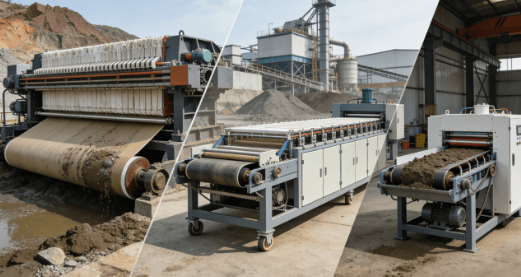
Filter press performance is not determined by pressure alone. Structural design, plate configuration, and press type all influence filtration efficiency, cake dryness, and operational reliability. Selecting the right filter press design ensures that the system matches both sludge properties and processing requirements.
Common filter press configurations
Plate and frame presses
Plate and frame presses allow flexible adjustment of cake thickness and are well-suited for operations with fluctuating sludge volumes. Their modular structure makes maintenance straightforward, though cycle times may be longer compared to other designs.
Recessed chamber presses
Recessed chamber presses are designed for higher pressure operation and improved sealing performance. They typically achieve lower final moisture content and are widely used in industrial applications where consistent cake dryness is required.
Membrane filter presses
Membrane filter presses apply secondary squeezing pressure after initial filtration. This additional step compresses the cake further, expelling trapped water and reducing cycle times. They are particularly effective when disposal volume reduction is a priority.
Insight 3: Operating parameters are as important as equipment
Even the most advanced filter press for sludge dewatering depends heavily on proper operation and process control. Incorrect operating parameters can negate the benefits of high-quality equipment and lead to unnecessary downtime.
Critical operating factors
Filtration pressure
Applying excessive pressure may damage filter media and reduce cloth lifespan, while insufficient pressure results in incomplete dewatering. Optimal pressure levels depend on sludge type, filter cloth selection, and press design.
Cycle time
Balancing feed time, filtration duration, and cake discharge is essential for maximizing throughput. Overextended cycles waste energy, while overly short cycles may leave excess moisture in the sludge cake.
Filter cloth selection
Filter cloth material, weave pattern, and permeability directly affect filtration speed and cake release. Choosing the correct cloth reduces clogging, simplifies cleaning, and lowers long-term maintenance costs.
Insight 4: Comparing filter press for sludge dewatering with alternatives
Understanding how filter presses compare to other dewatering technologies helps decision-makers select the most appropriate solution.
Technology comparison overview
| Technology Type | Final Cake Dryness | Energy Use | Operational Complexity | Typical Applications |
|---|---|---|---|---|
| Filter Press | High | Moderate | Medium | Municipal & industrial sludge |
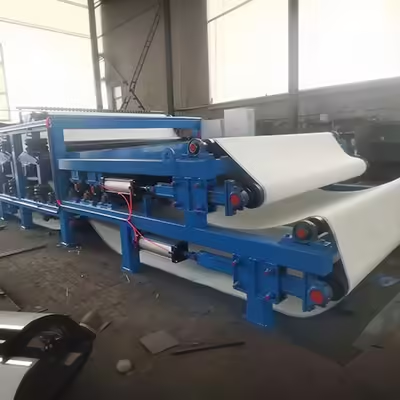
| Belt Press | Medium | Low | Low | Large-volume municipal plants |
| Centrifuge | Medium | High | High | Space-limited facilities |
Filter press systems typically provide the highest solids concentration, making them ideal when disposal volume reduction is a priority.
Insight 5: Cost efficiency goes beyond initial investment
While capital investment is often the first consideration, true cost efficiency depends on long-term operational performance. A poorly optimized system may appear affordable initially but generate higher expenses over time.
Cost-related considerations
Maintenance frequency
Regular maintenance ensures stable performance and extends equipment lifespan. Well-maintained presses experience fewer breakdowns and more consistent dewatering results.
Chemical consumption
Effective sludge conditioning minimizes polymer usage while improving filtration speed. Overdosing chemicals increases costs without necessarily improving results.
Labor requirements
Automation features such as automatic plate shifting and cloth washing significantly reduce manual labor needs, improving operational efficiency and safety.
Insight 6: Scalability and compliance drive long-term adoption
Modern wastewater treatment facilities require adaptable solutions that can evolve with regulatory changes and capacity demands. Filter press systems offer flexibility that supports long-term planning.
Regulatory and scalability factors
Environmental compliance
Filter press for sludge dewatering supports stricter disposal standards by achieving lower moisture content, reducing leachate risks and environmental impact.
System scalability
Modular press designs allow facilities to expand capacity incrementally. Additional plates or press units can be integrated without replacing the entire system, supporting future growth.
Final thoughts on filter press for sludge dewatering
Filter press for sludge dewatering remains a proven and adaptable solution for modern sludge management challenges. By understanding sludge properties, equipment design, and operational factors, operators can significantly improve efficiency and compliance.
For facilities seeking reliable solids reduction and long-term cost control, a well-selected filter press system continues to be a strong and practical choice.
FAQ
What is the typical moisture content after filter press dewatering?
Most systems achieve sludge cake solids between 30% and 45%, depending on sludge type and operating conditions.
Is a filter press suitable for small wastewater plants?
Yes, compact filter press systems are commonly used in small and medium-scale facilities due to their flexible operation.
How often should filter cloths be replaced?
Replacement frequency varies by application but typically ranges from several months to over a year with proper cleaning.
Does filter press dewatering require chemical conditioning?
In most cases, polymer conditioning improves filtration speed and cake release, especially for fine or organic sludge.
How does filter press dewatering impact disposal costs?
By reducing water content, it lowers transportation weight and landfill or incineration fees.